
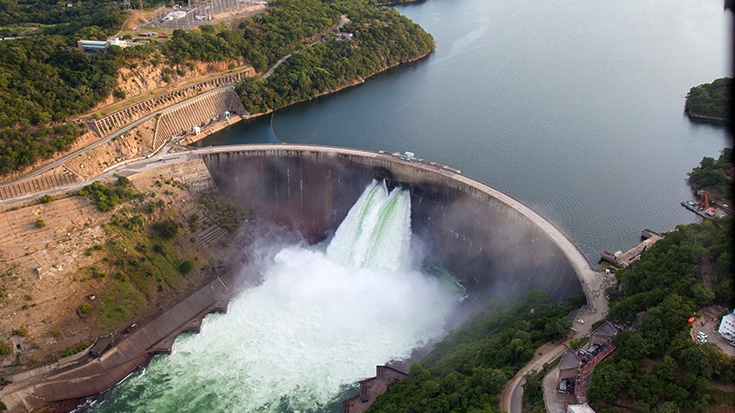
HARARE – The Zambezi River Authority (ZRA) says the Kariba Dam Rehabilitation Project (KDRP) is now 94% complete and remains on schedule for completion by the end of the fourth quarter of 2026.
The US$294 million project is aimed at securing the long-term safety and operational efficiency of the Kariba Dam, which serves as a key source of hydropower for Zambia and Zimbabwe.
The most advanced component is the Spillway Refurbishment. This Phase 1, which began in May 2019 and is being carried out by GE Hydro France in partnership with Freyssinet International, is 99% complete. It involves rehabilitating the upstream control system for all six sluice gates, including hydro-demolition, concrete repairs, installation of Built-In Parts, and rewatering and commissioning of the rehabilitated sluices.
The remaining works are the commissioning of the Gantry Crane and site demobilization.
Phase 2 of the spillway refurbishment, which started in August 2024, is about 70% complete and is expected to be finished by September 2026. Undertaken by Morris and Stub Engineers Joint Venture, it covers the design, manufacture, and installation of new hoisting systems and gate maintenance for all six sluice gates. The design, manufacturing, and delivery of all six hoisting systems were completed in 2025, with site installation commencing in December 2025. Installations are currently underway on sluices No. 1, 2, 5, and 6.
The refurbishment addresses deterioration caused by alkali aggregate reaction over six decades, which had made the sluice gates harder to open and close smoothly. The works are intended to restore full operability and reliability to the spillway system.
The KDRP comprises three components. The Plunge Pool Reshaping was completed and commissioned in September 2024. The Institutional Strengthening component focuses on enhancing dam safety monitoring, technical capacity, and governance systems within the Authority.
The project is funded by the African Development Bank, the European Union, the Government of Sweden, and the World Bank, with counterpart funding from the governments of Zambia and Zimbabwe.
ZRA said the rehabilitation is critical to mitigating the risk of uncontrolled water releases that could cause downstream flooding, infrastructure damage, and loss of life. It also includes an Early Warning System to improve communication with downstream communities during both scheduled and emergency releases from the Kariba Reservoir.
Once complete, the project is expected to enhance the sustainable management of the Kariba Reservoir and support reliable hydropower generation, a key driver of socio-economic development in both countries.