

HARARE (FinX) – Turnall’s first quarter of 2026 was not a clean turnaround. It was a better quarter, but not yet a convincing one. The company delivered stronger revenue, much stronger volumes, better cash generation and a narrower operating loss.
That is progress.
But the same update also exposes the fragility of the recovery: gross margin went backwards, input costs could not be passed on, the new Harare fibre cement plant only started commercial operations near the end of the quarter, and the business is still operating in a market where liquidity is thin, borrowing costs are high and formal industry is losing ground to informality.
This is not a company that should be celebrated yet. It is a company that has finally created the conditions for a turnaround, but still has to prove that the turnaround can produce real earnings power.
The operating environment gave Turnall a mixed hand. Exchange rates and inflation were broadly stable, helped by tight monetary policy, with USD inflation around 1.3 percent in March 2026.
Foreign currency inflows also improved during the quarter, supported by mineral and agricultural exports, especially gold and tobacco. For a manufacturer, that stability matters because it allows pricing, procurement and production planning to happen with fewer distortions. But stability did not translate into easy demand. Liquidity remained constrained, borrowing costs stayed high and consumer purchasing power was still under pressure.
The company also made a very pointed comment that Zimbabwe’s formal retail sector is under pressure from the informal sector, which it says now makes up 76.1 percent of the economy. That is not just a macro footnote. It is a direct threat to businesses like Turnall that need formal channels, structured investment, bankable customers and predictable distribution networks.
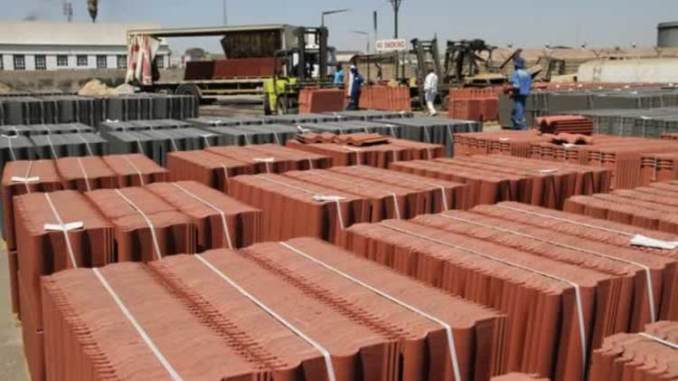
Turnall grew revenue by 19 percent compared to the same period last year, while sales volumes jumped 39 percent from 5,464 tonnes to 7,592 tonnes. Demand was driven mainly by fascia boards and concrete tiles, and production volumes increased by 14 percent in response to improved market demand.
The power situation was also generally stable, allowing production to continue with minimal disruptions. After a difficult 2025, this volume recovery is important because it shows that the market can still absorb Turnall’s products when pricing, supply and channel execution line up.
But the uncomfortable point is that volume grew much faster than revenue. A 39 percent volume increase against 19 percent revenue growth implies that average revenue per tonne weakened materially. That is the first warning sign in the quarter. It suggests that the growth was not purely pricing power led. It was partly mix led, with demand concentrated in products like fascia boards and concrete tiles, and partly volume led, where the business had to move more tonnes to generate less revenue per tonne.
That does not make the growth bad, but it makes it less powerful than the headline suggests. For a manufacturer emerging from losses, the quality of revenue matters more than the size of the revenue line.
The margin performance reinforces that concern. Gross margin fell to 20 percent from 22 percent in the prior year, mainly because of sharp increases in some input costs, particularly in March 2026 following fuel price increases. Management chose to absorb these costs and maintain selling prices.
That decision may have protected customer relationships and volume momentum, but it also tells investors that Turnall does not yet have enough pricing power to fully defend margins in a cost shock. This is the core tension of the quarter. The company sold more, produced more and generated more revenue, yet its gross margin compressed. That is not the profile of a business with strong pricing power. It is the profile of a business still rebuilding relevance in a difficult market.
Cost control remains the strongest part of the story. Operating expenses to sales improved to 27 percent from 37 percent in the prior year, reflecting ongoing cost containment. This matters because Turnall’s historical problem has not only been demand, but the inability to carry its cost base efficiently through weak cycles. A 10 percentage point improvement in the cost ratio is meaningful.
It shows management is still applying the discipline that became visible through 2025, when the business narrowed losses by cutting overhead intensity and improving internal efficiency. The operating loss improved by 19 percent to U$208,921 from U$258,524. That is progress, but it is also underwhelming when placed against the 39 percent jump in volumes.
A truly strong operating leverage story would have converted that volume recovery into a sharper reduction in losses.
This is why Q1 should be read carefully. Turnall is improving, but the improvement is still being diluted by gross margin pressure. Cost containment is doing a lot of heavy lifting. The danger is that investors mistake a narrower loss for a fixed business model. It is not fixed yet. A fixed business model would show stronger volume, stable or rising gross margin, declining opex intensity and a much faster movement toward operating profit.
Turnall has delivered two of those four things: stronger volume and lower opex intensity. The missing pieces are margin protection and actual profitability.
The biggest strategic event was the commissioning of the new Harare fibre cement sheeting plant on 15 March 2026. This is the plant that has carried much of the investment case since 2025. It is supposed to enhance production capacity, improve efficiency and enrich the product offering.
However, because commercial operations only started toward the end of the quarter, its contribution to Q1 production volumes was limited. The full impact is expected in later quarters as production stabilizes. That means Q1 2026 is not yet the new plant story. It is largely the last reading of the old business, with only a small glimpse of the new one.
This makes the next two quarters critical. In 2025, the market was waiting for the plant to change Turnall’s economics. In Q1, it has finally arrived, but it has not yet proved anything commercially. The plant must now do more than produce. It must improve quality, reduce unit costs, widen product range, strengthen pricing power and help defend gross margins against fuel, energy and logistics shocks. If it simply adds capacity into a weak pricing environment, it could become a bigger machine producing thin margins. If it supports better products and better route economics, it can finally shift Turnall from survival mode into an investable recovery.
Cash generation was another positive, but even here the quality of the number must be examined. Net cash flows from operating activities were positive at U$346,321, compared to a U$235,115 outflow in the prior year. That is a major swing and supports the view that the business is becoming more disciplined. However, working capital movements contributed positively to liquidity, and trade receivables and payables both decreased by about U$2.2 million following the offset of some prepayments against outstanding invoices from the same supplier. That means the cash flow improvement is real, but partly assisted by a specific balance sheet clean-up.
Investors should therefore not only ask whether Turnall generated cash in Q1, but whether it can generate cash repeatedly as the Harare plant ramps up and inventory, receivables and distribution demands rise.