
By Staff Reporter
GENEVA- Zimbabwe has reported progress in expanding refugee protection and self-reliance but warned that rising global displacement is placing growing pressure on host countries in the Global South, calling for stronger and sustained international support.
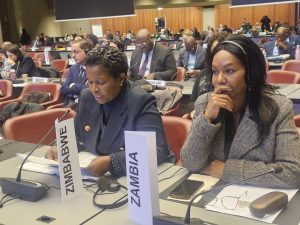
The update was delivered by Deputy Minister of Public Service, Labour and Social Welfare Mercy Dinha at the 2025 Global Refugee Forum Progress Review Meeting held in Geneva from December 15 to 17.
Dinha said Zimbabwe remains committed to the Global Compact on Refugees and the 2016 New York Declaration. She said national policy is focused on self-reliance, durable solutions and improved conditions for asylum seekers.
“The protracted nature of displacement in the Global South is deeply concerning,” Dinha said.
“It is largely driven by conflict, wars and climate change-induced natural disasters.”
She said Zimbabwe believes sustainable peace in countries of origin is the most durable solution to forced displacement.
“Ending wars is essential for safe, humane and dignified returns,” she said.
Dinha said Zimbabwe has made tangible progress on pledges made at the 2023 Global Refugee Forum. She cited the allocation of 175 hectares of irrigable land to refugee farmers at Tongogara Refugee Camp.
“This has benefited 590 refugee farmers and supports food security for refugee families,” she said.
On legal identity, Dinha said access to civil documentation remains a priority.
“Refugees are now receiving machine-readable refugee passports, identity cards and birth certificates,” she said.
She added that in 2024 the government extended the validity of refugee identity cards from two to five years.
Zimbabwe is also reviewing its Refugees Act to align it with evolving global standards.
“The review seeks to promote integration opportunities, access to work and inclusion in social protection,” Dinha said.
She noted that refugees in Zimbabwe are already included in national social protection programmes.
Dinha said refugee commitments have been integrated into the National Development Strategy running from 2021 to 2030.
“Our goal is an upper-middle-income economy by 2030, anchored on inclusive growth,” she said.
Zimbabwe currently hosts 13,896 refugees and asylum seekers. Dinha said progress has been achieved through cooperation with the UN High Commissioner for Refugees and other partners.
“Responsibility-sharing remains critical,” she said.
However, she warned that government efforts alone are not enough. “Our commitments must be matched with sustainable donor funding to ease the hosting burden,” Dinha said,
She also paid tribute to UN High Commissioner for Refugees Filippo Grandi. “We appreciate his unwavering support to Zimbabwe,” Dinha