
By Staff Reporter
Bindura’s worsening water situation has eased after Mutapa Gold Resources and Bindura Municipality invested US$3 million in a new pipeline linking the town to Masembura Dam, adding a second raw water source after Mwenje Dam fell to just 36 percent capacity last year.
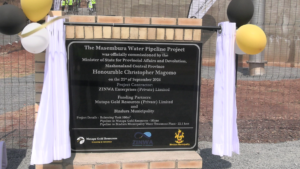
The 22.1-kilometre Masembura Water Transmission Pipeline, commissioned yesterday, was jointly financed by Mutapa Gold Resources and Bindura Municipality, with the mining company funding 60 percent of the project and the municipality contributing the remaining 40 percent.
Implemented by the Zimbabwe National Water Authority (Zinwa), the project includes a 500-cubic-metre balancing tank and allows Bindura to draw raw water from Masembura Dam alongside the Mazoe River.
The intervention comes after the town faced the prospect of severe water shortages in April 2025, when Mwenje Dam, one of its key water sources, had fallen to 36 percent of capacity while the dry season was still under way.
Mutapa Gold Resources chief executive officer Patrick Maseva-Shayawabaya said the declining dam levels raised concerns not only for Bindura residents but also for Freda Rebecca Gold Mine, which requires water for its operations.
“That was a clear red light to us that we potentially faced not having processing water at Freda Rebecca Gold Mine in the latter part of the season and that Bindura Town would also not have some water for human consumption,” he said.
While Mwenje Dam was depleting, Masembura Dam was about 90 percent full, prompting Mutapa Gold Resources to support the long-delayed project as a way of diversifying the town’s water sources.
“As Mwenje Dam was basically depleting, Masembura Dam was at that time around 90 percent full, so we quickly concluded that to avert a disaster of a shortage of water, we had to invest in what was then a long-talked-about Masembura Water Pipeline,” Maseva-Shayawabaya said.
The pipeline had remained on Bindura Municipality’s plans for 34 years, with Town Clerk Evelyn Madziire saying the project had been on the municipality’s shelves since 1992.
She described its completion as a “game changer” for the town, saying reliable water supplies were critical to improving service delivery and attracting investment.
“Water is the backbone of investment and a major driver of economic activity, without water there is no development to talk about,” Madziire said.
The new source has also begun reducing the cost and time associated with water treatment and reservoir replenishment, according to Mashonaland Central Provincial Affairs and Devolution Minister Christopher Magomo, who was the guest of honour at the commissioning.
“Bindura can now draw raw water from both Mazoe River and Masembura Dam and we are reliably informed that raw water from Masembura Dam has significantly reduced water treatment chemical costs and overall production costs while the use of two water sources has reduced the time required to fill reservoirs,” Magomo said.
The minister said Bindura’s previous reliance on the Mazoe River had exposed the town to water quality challenges, particularly from illegal alluvial gold mining upstream.
He said the pipeline demonstrated the potential of partnerships between government, local authorities and private companies to address infrastructure gaps.
“This is the kind of development we seek to see across our communities. Development that brings tangible improvement in the quality of life of people. Government cannot do everything alone,” Magomo said.
He described water as an economic enabler, saying reliable supplies were essential for businesses, industries, mines, hospitals, schools and residential developments.
For Mutapa Gold Resources, the investment forms part of its stated approach to ensuring that mining operations deliver benefits beyond production.
“Our approach to corporate social responsibility is guided by a simple but powerful vision, and that is to leave the local communities which we operate better than we found them,” Maseva-Shayawabaya said.
“We believe that mining must create value beyond production figures, beyond profitability, and beyond the life of a mine. It must improve lives, support local resilience, and contribute meaningfully to the social and economic development of the communities that host our operations,” he said.
However, the pipeline does not resolve all of Bindura’s water infrastructure constraints.
The town’s existing water treatment plant was designed to serve a much smaller population and requires expansion, while its distribution network also needs to be extended to reach growing residential and developing areas.
The Masembura pipeline therefore gives Bindura a second source of raw water, but the municipality now faces the challenge of ensuring that treatment and distribution capacity keeps pace with the town’s growth.
For a town that was staring at dwindling water reserves in 2025, the US$3 million project has provided a critical new lifeline, with Mutapa Gold Resources helping to turn a long-standing plan into infrastructure now supplying Bindura with an additional source of water.