

Itai Ndongwe
BULAWAYO – A low-cost, air-cured tobacco production model is reducing farming expenses and limiting deforestation in Matabeleland, as the Tobacco Industry and Marketing Board (TIMB) expands tobacco marketing operations in the region.
TIMB this week opened contract sales floors at the Zimbabwe International Exhibition Centre in Bulawayo, where more than 300 farmers from Matabeleland North and South delivered over 1,000 bales during the opening trading period.
The programme is centred on Natural Cured Virginia and Burley tobacco varieties, which are cured using natural airflow instead of firewood. TIMB says the method significantly lowers production costs and suits Matabeleland’s dry conditions, where access to water and energy remains limited.
Production costs for the new model average about US$471 per hectare for 4.5-hectare plots, compared to more than US$1,100 per hectare under conventional flue-cured tobacco systems.
TIMB Chief Executive Officer Emmanuel Matsvaire said the model was improving profitability for growers while maintaining market quality standards.
“Small-scale farmers are averaging 1,600 kilogrammes per hectare, while commercial growers are reaching about 2,000 kilogrammes per hectare,” Matsvaire said on the sidelines of the sales floor opening.
“At average prices of US$2.50 per kilogramme, the model offers viable returns for both small-scale and commercial farmers in Matabeleland.”
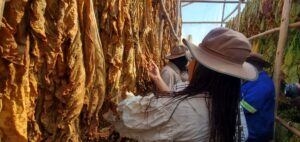
Farmers use specially designed air-curing barns that rely on ventilation instead of wood-fired heat. Growers say the process produces the bright lemon-coloured leaf preferred by buyers while reducing pressure on forests.
“We use these barns for air curing, and they produce the bright lemon colour preferred on the market,” one commercial farmer said.
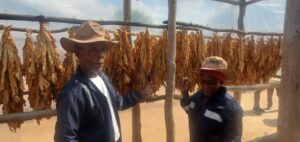
“After harvesting, we grade the leaf before placing it into the air-curing barn.”
Farmers in the region say the project has helped them continue tobacco production despite erratic rainfall.
A farmer from Matabeleland, Mr Khumalo, said he expanded from one hectare to two hectares after recording encouraging returns during his first season.
“The first crop did well despite the dry spells and low rainfall. I managed to get good prices at the auction floors,” Khumalo said.
He said farmers initially relied on manual irrigation systems and water drawn from nearby dams, but labour shortages affected production. This season, growers shifted to irrigation systems installed through TIMB and government support programmes.
“Without the irrigation system, many of us would have struggled to continue,” he said.
Khumalo added that the air-curing barns had improved leaf quality compared to the previous season, when tobacco cured on open racks was damaged by rain.
TIMB said it has established village business units along irrigation lines to support tobacco production and reduce the impact of water shortages. The board is also supplying curing barns to participating farmers at no cost.
The programme currently involves 390 growers, including 345 small-scale farmers. Production areas have expanded from Marula to Plumtree and along the Shangani River.
TIMB expects the project to grow to 1,000 hectares by the 2027 season, with projected output of about two million kilogrammes from Matabeleland.
Farmers involved in the programme say tobacco farming has already improved household incomes and living standards.
“I started tobacco farming last year, and the income helped me improve my home,” one communal farmer said.
TIMB said buyers had already tested the crop’s nicotine and sugar content and were satisfied with the quality.
Matsvaire said the board was targeting average prices of around US$4 per kilogramme this season and planned to extend the model to other provinces with suitable water sources.
Trials have already been conducted in Mwenezi and Beitbridge, while areas around Tokwe-Mukosi Dam in Masvingo are being considered for expansion.